German for Nurses: From A1 to B2 for a Nursing Job in Germany (2026)
SSkillcase team·Updated ·9 min read
B1 vs B2 explained
Goethe and telc Pflege exams
Study plan and timeline
In this guide12 sections
German is the one requirement no nurse can skip. Your degree gets you in the door, but the language decides how fast you can start, which job you get, and whether your qualification is fully recognised. This guide explains the levels, the exams that count, how long it really takes from India, and how to study without losing a year.
Short answer: most German state authorities require B2 German (with nursing vocabulary) to recognise you as a registered nurse. Some routes let you travel with B1 or even A2 and finish B2 in Germany, but B2 is the level you need in the end.
Which German level do nurses need?
Germany recognises nursing qualifications at state level, and each state's authority sets the language proof it accepts. The official recognition portal lists B2 German with job-related (nursing) vocabulary for the title of registered nurse (Pflegefachfrau / Pflegefachmann) in most states. The proof can often be sent after you apply.
Doctors need more: B2 general German plus a medical language exam (Fachsprachprüfung) at C1. See our guide for doctors moving to Germany.
What each level means for a nurse
The levels come from the Common European Framework of Reference (CEFR). Here is what they mean on a hospital ward, with the Goethe-Institut's estimate of guided learning hours needed to reach each level (one teaching unit is 45 minutes).
CEFR German levels for nurses
Level
What you can do at work
Guided learning hours (Goethe estimate)
A1
Introduce yourself, understand simple instructions, basic greetings with patients
60–150
A2
Short routine conversations, simple questions about pain, food and sleep
150–260
B1
Handle most everyday situations, talk to patients about their care, write short notes
260–490
B2
Hand over patients, talk to doctors and families, document care, follow fast speech
450–600
C1
Complex, precise communication (required in a medical exam for doctors)
600+
Hours are cumulative from zero and vary with the course and your study time (Goethe-Institut).
Which German exams count?
Authorities accept certificates from recognised providers. The ones nurses use most:
Goethe-Zertifikat B1 / B2: the best-known exam, offered in India by the Goethe-Institut (Max Mueller Bhavan). From B1 upwards it is modular: reading, listening, writing and speaking are separate modules, so if you fail one you retake only that one. You need 60% in each module.
telc Deutsch B1·B2 Pflege: an exam written for nursing staff, with tasks such as a care admission report. It tests both levels in one sitting and certifies B1 or B2 depending on your score (telc).
ÖSD and TestDaF: also widely accepted; check that your state authority lists the one you choose.
One report: an admission report or a biography report
30 min
Speaking
3 parts in pairs, with 20 min preparation
about 16 min
Check the current format on telc.net before you book; formats are updated from time to time.
Where to take the exam in India
The Goethe-Institut runs Max Mueller Bhavan centres in Bengaluru, Chennai, Kolkata, Mumbai, New Delhi and Pune, and partner Goethe Centres in Chandigarh, Coimbatore, Hyderabad and Thiruvananthapuram (Goethe-Institut India). Exam dates fill up weeks ahead, so book as soon as your teacher says you are ready.
How long does it take to reach B2 from India?
With a structured course and daily practice, most working nurses take 8 to 12 months from zero to a B2 certificate (450–600 guided hours at about 2 hours of class a day, plus self-study). Full-time learners can be faster. A realistic plan:
A realistic study plan from zero to B2
Phase
Typical duration
Goal
A1
1.5–2 months
Alphabet, pronunciation, everyday phrases, first ward words
A2
2–2.5 months
Simple conversations, past tense, describing symptoms
B1
2.5–3.5 months
Everyday fluency; take the B1 exam (needed for Triple Win visas)
B2
2.5–4 months
Nursing communication, handovers, documentation; take the B2 exam
Durations assume about 2 hours of class plus 1 hour of self-study a day.
Nursing vocabulary (body parts, symptoms, medication, care routines) should start from A2, not after B2. The interview with a German hospital and the recognition exams both test it.
How to study German as a working nurse
Fix a daily slot. One hour every day beats seven hours on Sunday. Use your commute for listening practice.
Speak from week one. Speaking is where many learners lose marks, not grammar. Practise answering questions out loud and record yourself.
Learn ward German early: handover phrases, pain scales, mobilisation, wound care, medication times.
Take mock exams at B1 and B2 under timed conditions before you book the real exam.
Don't skip levels. Jumping to B2 without solid B1 grammar is the most common reason for repeating exams.
How your German level affects your salary
German is also the biggest factor in your pay. Until you have B2 and full recognition you usually work as a care assistant; afterwards you are paid as a registered nurse. In public hospitals registered nurses start at about €3,510 gross a month in 2026, while assistant pay is lower and often close to the legal care minimum wage. Every month you save on the way to B2 is a month at nurse pay. See nursing salaries in Germany.
German for your family
Spouses of many skilled workers and EU Blue Card holders don't need to prove German before joining, but daily life is much easier with it. Starting your spouse on A1 while you study B1–B2 helps with school, doctors and shopping from the first week. Children usually learn German quickly at school. More in life in Germany.
German for a nursing Ausbildung
If you want to train as a nurse in Germany instead (the three-year paid Ausbildung), nursing schools usually ask for B1–B2 German before you start, because lessons and exams are in German. The same study plan applies; aim for B2 to follow lessons comfortably.
What a good German course for nurses includes
Live classes with a teacher for speaking, plus self-study material for vocabulary and grammar.
Nursing scenarios from A2: admission, handover, medication rounds, talking to relatives.
Exam preparation for the certificate your state accepts, with timed mock exams.
Interview practice for German employers.
Small groups so that everyone speaks in every class.
How the exams are marked
The Goethe-Zertifikat B1 and B2 are modular: reading, listening, writing and speaking are marked separately, and you need at least 60% in each module to pass it. You can retake only the modules you failed. The telc Deutsch B1·B2 Pflege exam is a single exam with nursing situations (handover, talking to patients and relatives, documentation); depending on your score you receive B1 or B2. Check which certificates the authority in your state accepts before you book.
A sample week for a working nurse (about 12–15 hours)
Day
Focus
Time
Mon, Wed, Fri
Live class: grammar and speaking
90 min each
Tue, Thu
Vocabulary review and listening (podcasts, ward dialogues)
45–60 min
Saturday
Writing practice: emails, short reports, a care note
90 min
Sunday
One timed mock section and a speaking session with a partner
90 min
Short daily practice beats long weekend sessions: little and often is how vocabulary sticks.
Common mistakes that cost nurses months
Choosing an exam your state does not accept. Check the recognition authority's list first.
Booking the exam too late. Popular centres can be booked out weeks ahead; plan the date when you start B1.
Studying only for the exam. Passing B2 with no speaking practice makes the hospital interview and the first months at work much harder.
Paying for 'guaranteed' certificates. Only the exam provider issues certificates, and authorities verify them.
Learn German with Skillcase
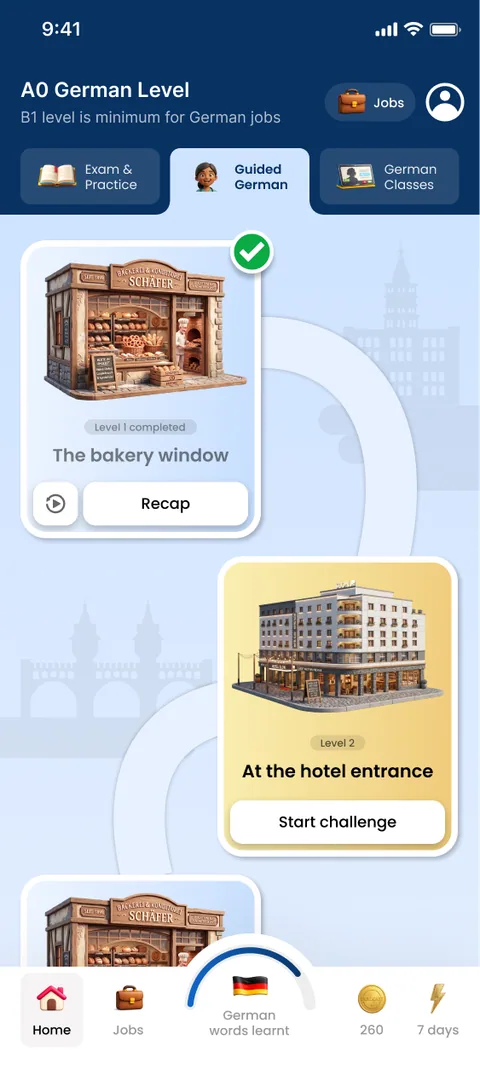
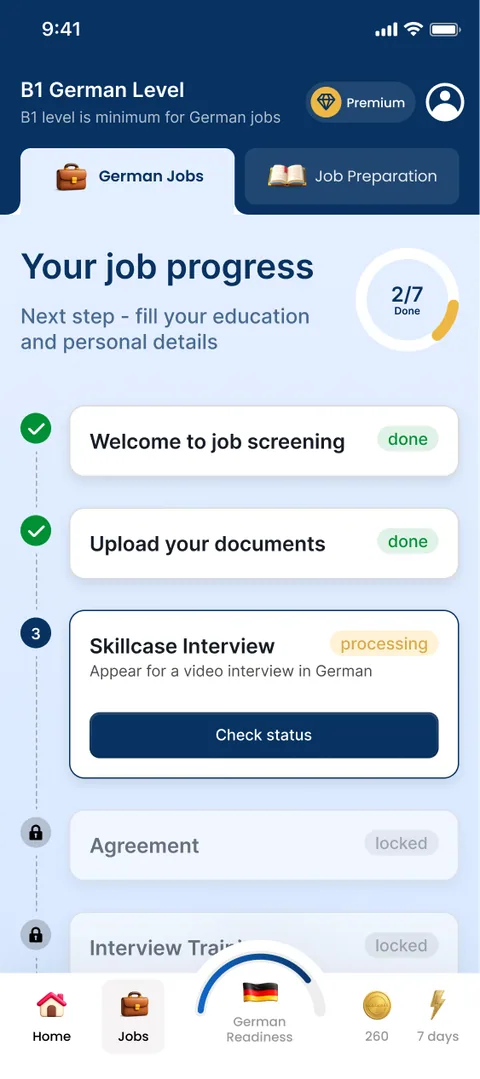
Skillcase teaches German from A1 to B2 for healthcare professionals, with live classes, nursing vocabulary from the start and speaking practice in the Skillcase app. See the programs and fees, or read how recognition works in our nursing recognition guide.
Frequently asked questions
Is B1 German enough to work as a nurse in Germany?
B1 can be enough to travel on some routes, for example the Triple Win programme asks for at least B1 at the visa application. To be recognised as a registered nurse, most states require B2 with nursing vocabulary, so you complete B2 in Germany.
How long does it take to learn German from A1 to B2?
The Goethe-Institut estimates 450–600 guided learning hours to reach B2. For a working nurse with about 2 hours of class a day plus self-study, that is typically 8 to 12 months.
Which is better for nurses: Goethe B2 or telc B1·B2 Pflege?
Both are widely accepted. telc Pflege uses nursing situations, which many nurses find easier to prepare for; Goethe is modular, so you can retake a single failed module. Check which certificates your state authority accepts.
Can I take the Goethe exam in India?
Yes. Max Mueller Bhavan centres in Bengaluru, Chennai, Kolkata, Mumbai, New Delhi and Pune, and Goethe Centres in Chandigarh, Coimbatore, Hyderabad and Thiruvananthapuram run Goethe exams.
Do doctors need a different German level?
Yes. Doctors need B2 general German and must pass a medical language exam (Fachsprachprüfung) at C1 level, run by the state medical chamber.
The four visa routes for Indian nurses going to Germany, what each needs, the documents for a national (D) visa, fees, how to apply through the German missions in India, and how long you can stay.
How Germany recognises an Indian B.Sc Nursing or GNM qualification: who decides, the documents, fees, the deficit notice, and the choice between a knowledge test and an adaptation course.
Everything Indian nurses need to work in Germany: eligibility, German level, recognition, visa routes, documents, costs, salary and a step-by-step timeline from India to a German hospital.
Updated ·9 min read
Your next step
Ready to start your move to Germany and beyond?
Create your profile in a few minutes. An advisor will suggest the roles that fit you.